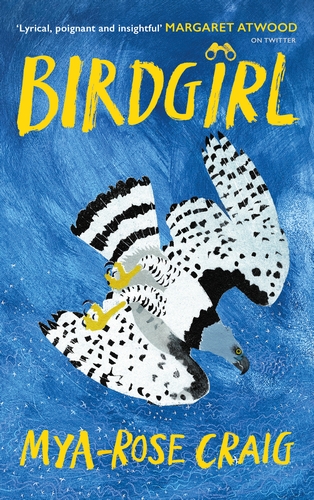
Mya-Rose Craig (2022) Birdgirl. London. Jonathan Cape.
This book is a passionate account of a young woman’s love of birding- how it transformed her life, helped her family cope better with difficult times, and led her to a broader awareness of both environmental and social issues. It is an excellent portrayal of how the conservation sense of place can develop from birding. Her father was a keen birder and soon converted his Bengali wife and two daughters.
The Joy
“There is nothing like the moment when your target bird appears. And when you share these minutes with like-minded souls, is nothing better… The sight of a single bird, blown against all the odds, off its migratory course to spend a little time in a strange new land, is a singular experience, a nirvana, a gorgeous creature to be burned into the memory forever”(p. 5).
“Birdwatching has never felt like a hobby; it is not a pastime I can pick up and put down, but a thread running through the pattern of my life, so tightly woven that’s there is no way of pulling it free and leaving the rest of my life in tact” (p. 23).
Birding or Twitching?
I discussed the role of the birding list in my book and Mya also has many lists. However, she was keen to point out that seeing a new bird was more than completing a list. She does a bird list for the year: “it was no mere box-ticking exercise”. “Familiar birds were viewed through fresh eyes; I was more aware, more curious, conscious and focused than I had ever been before as I identified and differentiated between species.” She got to appreciate everyday birds, “watching each one as if it were a first for the UK, examining and noting everything about it, the tiniest details in the feathers, the nuance of colour, admiring and feeling amazed each time I identified a new bird”(p. 33-34).
Ethical and Community Tourism
Her family travelled all over the world to see birds. She stresses how many of the companies they went with were committed to eco-tourism that supported the local community. Her experiences show how this kind of tourism can provide an alternative livelihood to Extractivism and hunting.
One their trip to Ghana, they went with a company that was committed to ethical and sustainable tourism. It was a community-run business and employed local guides. The reserve was created to protect an endangered species- the Picatharte (p. 98).
They went to find Shoebills in the Mabamba swamp in Uganda. The Shoebills used to be a bad omen for locals because it eats the lungfish that the fishermen wanted to catch and they had hunted them to near extinction. Now, many fishermen rent their boats out to guides and many themselves have retrained (p.195).
Not Just Birds
She appreciates that it is landscape conservation that is needed. “If you get the landscape right- if the habitat is welcoming- then the birds will come. …To engage with birds is to engage with landscape and with nature; for me they walk hand in hand” (p. 205).
In addition, it is local people who know this landscape best. Her experience in northern California was a turning point for her.
Since the early 2000s the indigenous people of Yurok in northern California have been actively engaged in restoring the rivers, forests and prairies of their ancestral homelands in Redwood National Park, in preparation for the return of the Condor. The Condor plays a central role in their spiritual beliefs and rituals. It is also a critical part of the ecosystem for them.
“Inspiring projects such as this, driven by local indigenous communities, are, for me, conservation at its best, combining people, wildlife, science, and culture to reinstate a natural harmony to the world” (p. 247).
When in Lone Pine, California she met a local birder, who had grown up on the Piaute/Shoshone Indian reservation on the eastern side of the Sierra Nevadas. He invited them to look at the birds in his garden. In his early teens, Russell had turned to the outdoors for solace, escaping the poverty on the reservation. Hiking fuelled his desire to work in the environmental sector.
“As an indigenous American, his connection to the land was significant, it was part of his heritage, and now, a biologist, he was using nature to help others to find their way back to that connection, and helping local disaffected teens find their own ambition (p. 251).
This encounter got her thinking about what she could do to support what she calls Visually Minority Ethnic (VME) people engage with nature and was the catalyst for the actions she was soon to take.
For more information see: https://www.birdgirluk.com/ and the post on nature and mental health: https://landforwhatlandforwhom.org/2023/08/03/nature-and-mental-health/.
Other resources
- https://www.wildlifeworldwide.com/group-tours/quest-for-the-picathartes
- https://www.eastafricantrails.com/mabamba-swamp/, https://www.audubon.org/news/from-canoes-fishermen-guard-africas-famous-shoebills-against-poachers, https://angama.com/blog-posts/east-africa-travel/in-search-of-the-shoebill/
- https://www.nationalparks.org/news-and-updates/media-appearances/the-yoruk-tribe-celebrates-partnership-with-npf-nps-and-partners-for-condor-recovery and https://www.yuroktribe.org/
 Land for What? Land for Whom?