I have attended this conference for the past 5 years. It has been a way of furthering my understanding of issues I know little about. This year I helped to organise (with the People’s Land Policy) a session on the Rural-Urban Divide, inspired by the book by Anna Jones on this subject. Like my own book, she has shown the different perspectives from the inside. She is a daughter of a farmer but went to the city for university. She is ideally placed to see things from both sides. I managed to contact Anna who was very happy to be part of the panel. Here is a detailed account of the panel presentations.
Bridging the Rural-Urban Divide: Building Common Ground
Summary
There is no doubt that there is a rural-urban divide, expressed in terms of culture, life experiences, perceptions, or political outlook. However, if we are to create a just, sustainable and secure food system then we need food growers in rural areas to find common cause with those who buy the food, most of whom live in urban areas. This session will consider the root of the problem and look at initiatives which are helping to overcoming the divide, thus contributing to a united food movement with growers and eaters, rural and urban residents coming together in a shared understanding.
Session Organisers
The People’s Land Policy organised this session at the Oxford Real Farming Conference 2025, together with the following speakers:
Anna Jones is a rural affairs journalist, author, broadcaster, and television producer. She’s also a Nuffield Farming Scholar and a farmer’s daughter from the Welsh Borders. She worked for many years on BBC One’s Countryfile and produced the Channel 4 series Our Dream Farm with Matt Baker. She is a familiar voice on BBC Radio 4, including the documentary series Battle Grounds: Culture Wars in the Countryside, Farming Today and On Your Farm. She has written articles for The Guardian, Farmers Guardian and Farmers Weekly and even did a spell in Ambridge as Agricultural Advisor on The Archers. Anna’s career took an unexpected turn after her Nuffield Farming Scholarship in 2016/17, which looked at how the media portrays farming and country life to the public. She quit her staff job at the BBC in 2018 to set up Just Farmers, an agri-comms project aimed at connecting journalists and programme makers with independent, authentic voices at the grassroots of farming. Anna’s mission to improve the national conversation around rural issues inspired her first book Divide: The relationship crisis between town and country, published in 2022.
Jade Bashford works for the Real Farming Trust. Over the last 30 years she’s worked in both urban and rural areas on food and farming issues with farming and community groups. Her current projects are about inclusion and food poverty. She’s been interested in identifying and sharing practical models for community control of food and farming such as CSAs and trading hubs. Today she’ll tell us about LUSH, Linking Up Suppliers and Hubs which makes a trading and social link between a farm and a food poverty group.
Liis Nukis
For the past two years Liis has been working with the Twinning Project put on by the Real Farming Trust in Bristol. The aim of the project is to tackle the divide between urban and rural communities by making connections through food and social justice. She is also a first-generation farmer at Three Pools permaculture farm and the Land and Projects Officer for the Biodynamic Land Trust.
Dee Woods
Dee is an award winning food system leader. A passionate knowledge broker, ideator, pollinator and weaver who advocates for good food for all and a just food system. Her work meets at the nexus of human rights, food sovereignty, agroecology, community, policy, decolonial research, reparations, culture, climate and social justice. Dee wears many headwraps including being a director and the food justice policy coordinator of the Landworkers Alliance, a member of the LION collective and co-founder of the African and Caribbean Heritage Food Network and Granville Community Kitchen
Introduction: Bonnie VandeSteeg
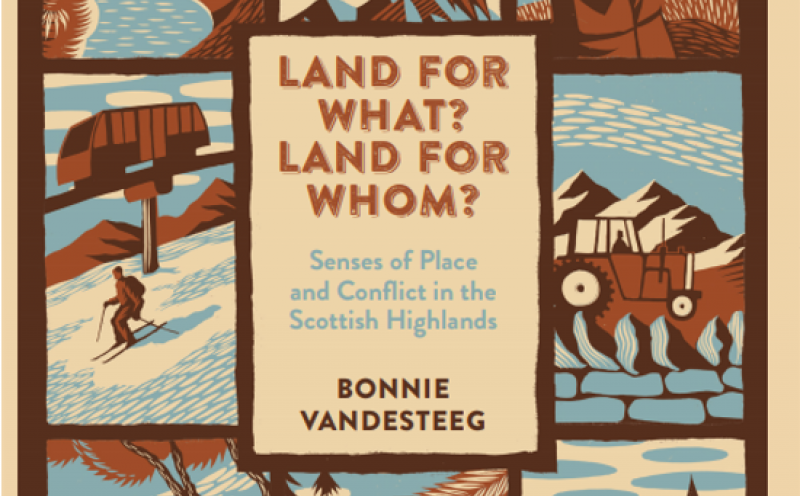
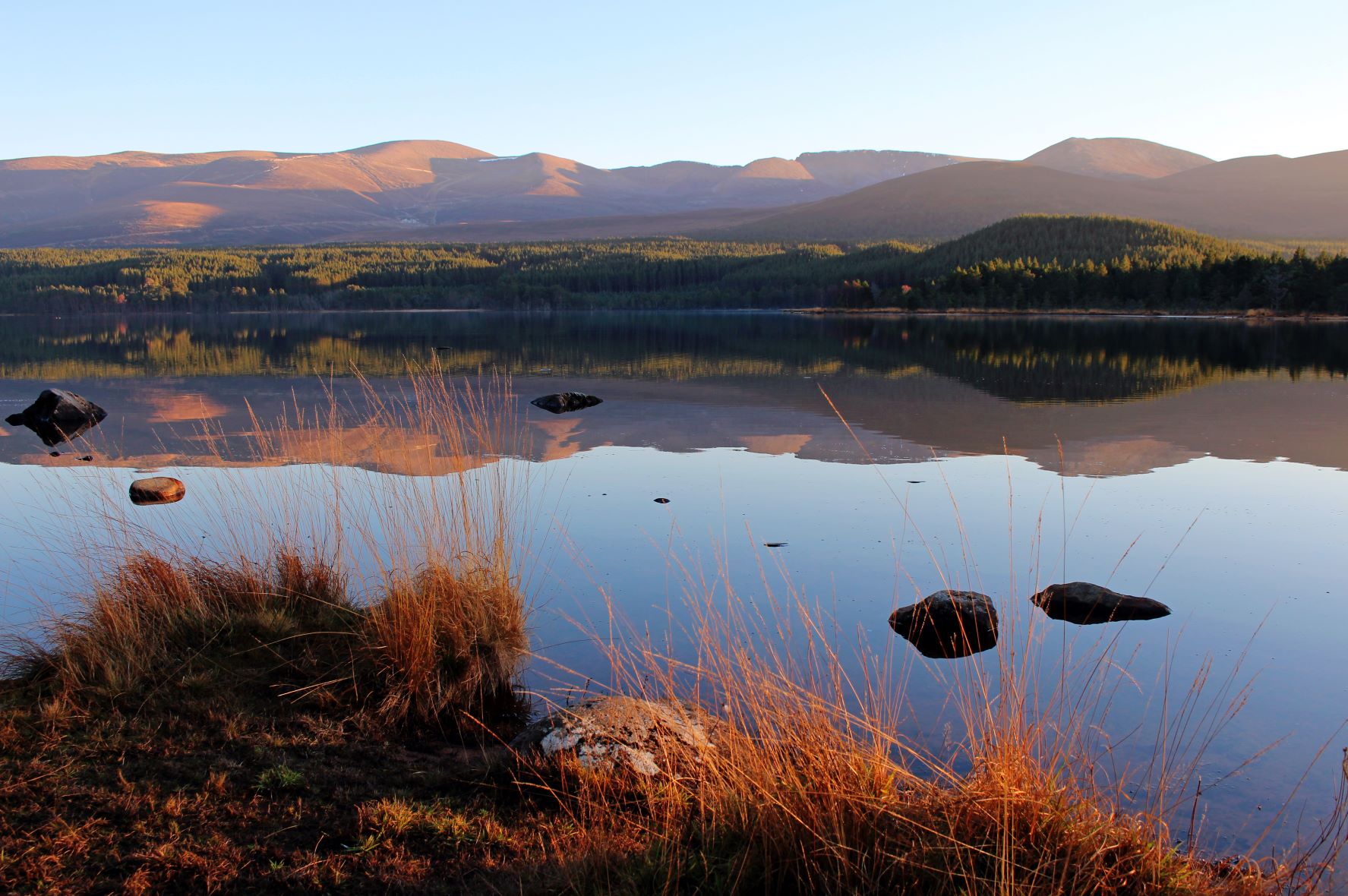
My research: divisions within the same geographical space- based on how people related to the land. Farmers and sporting estate workers saw the land very differently from those working in the outdoor industry, conservation or tourism. This could lead to local conflicts, eg over the reintroduction of the beaver, the setting up of the national park. So how to overcome these divisions? I found many examples of people coming together, conservationists working with farmers, farmers joining local mountaineering clubs, son of a sporting estate worker getting a job in conservation. Key is interpersonal contact and seeing things from the others perspective. It was a personal journey for me as well. I could appreciate different senses of place and this led me to be interested in all land-related issues. One of these was debates around food and farming. This session was inspired by reading Anna Jones’ book.
- Urban-rural divide clearly exists: lack of understanding of the different difficulties people have, what it is like to live in a city or a rural area
- Issues- Urban: don’t understand why farmers get subsides, many struggle to afford food, feel unwelcome in the countryside. Rural: many struggling to survive and make ends meet, hard work, need to be paid more for what they produce, feel undervalued.
- Food is the common factor: people in the cities need what the farmers produce. But it seems as if goals are contradictory: one wants lower prices, one wants higher prices- supermarkets in the middle- making profits at the expense of both
- If we are going to make the food system one in which all farmers make a decent living and urban eaters are able to afford could quality food, then we need to find ways of making common cause, promote understanding and unite to transform the system.
- This session will look in more depth at the cause of the divide and present some ideas of overcoming it
The Divide
Anna Jones
1. What Is The Urban/Rural Divide?
- Not always about where you live – it’s about how you think, how you identify.
- You may have moved to a rural area and not quite crossed that invisible divide with the ‘true locals’.
- Maybe, like me, you moved from a deeply rural area to a city and always felt like a square peg in a round hole – never quite fitting in. I’ll go into some of the differences shortly.
2. Why Does It Exist?
- Result of industrialisation.
- I’ve travelled the world exploring how urban and rural people get on with each other. What I find again and again is it’s the post-industrial, urbanised nations (like the UK) which have the biggest divides.
- Developing countries, every African country I’ve visited, Ireland – not so much. They never industrialised in the same way. Their ties to the land were not severed as long ago as ours. In the UK, we have many generations of separation from the job that we once all did – farming.
3. How Does The Divide Show Itself?
In many ways.
- Socially, recreationally – hunting, shooting etc
- How we view our natural environment (and what it’s for)
- Food and farming. As Bonnie rightly identified – two sides of the same coin but how we experience them can be worlds apart in an urban and rural context.
- Politically – I’m from an average working class, rural, conservative family. I grew up with a deep affection for the Royal Family, Church of England and the Armed Forces. I would curtsey to the local hunt as a child. I never met a Socialist until I moved to Birmingham when I was 25. Rural conservatism runs through my bones. I think I remain instinctively conservative, but city life has made me philosophically ‘lefter’. I’m deeply grateful for that balance and perspective in my life – I hope I can look at things without the anger and hate that I believe is ruining us as a society. More on that later
4. Why Does Any Of This Matter?
- Because we need each other – 86% of people live in urban areas yet 70% of our landscape is farmed/managed privately. The power to solve our biggest problems is weighted equally between urban and rural. Neither side holds all the cards.
- That means we can hold each other up, get in each other’s way, fight each other…OR we can work out how to benefit both and move forward together.
- The urban/rural divide is toxic because of how we too often perceive each other.
- What’s really dangerous is how those perceptions – these FEARS – get exploited by people who benefit from our division. Certain politicians, my own profession (the media), owners of social media platforms, columnists and opinion writers. Anyone who enjoys poking sticks in hornets’ nests basically.
- What Are Those Perceptions?
Urban To Rural:
- On the urban side, many people are oblivious to the divide. They have nothing against rural people, they love the countryside, love farming. A poll in 2024 (NFU) showed 74% of the public have a favourable view of farmers and growers, second only to nurses.
- From my years of research, I can confidently say urban people don’t spend as much time thinking about the urban/rural divide because it doesn’t feel particularly relevant to them.
- However, that can lead to a lot of unconscious bias about rural people and their culture. You can have a great intellectual understanding of the countryside but a lack of real cultural understanding. Speaking from personal experience, urban people sometimes lack the humility to recognise that. And that’s the rub for many rural folk.
Rural To Urban:
Most of my work is with the farming community – so I’m going to caveat my next point by referring to the rural agricultural community. They are very conscious of the urban/rural divide and feel it palpably. What I encounter regularly is a charitable view of urban life and an uncharitable one.
I’ll start with the mean one:
- Urban people are clueless about the countryside, they don’t know how to respect it, behave properly within it and have zero understanding of the work that happens there in order to produce food, fibre and timber.
- Urban people have an easier life with better services, better access to services, more disposable income and more convenience.
- Urban people don’t work as hard as farmers do, with their 9 to 5 jobs and they get in the way on their days off walking and cycling in the countryside.
- Farmers keep urban people alive – but they don’t know it, or care.
The nicer view!
- Urban visitors to the countryside are different to shyer country folk – more curious, more talkative, and super keen to learn. Farmers welcome this interest and want to open up their farms and show people what they do.
- Urban people lack the access to green space rural people take for granted (many farmers openly admit they could never live in a town or a semi-detached house, or ‘on top of other people’) and they are conscious of their privilege. Many wish to share it.
- Farmers have more freedom – to roam, to manage their own working hours, their life and work is intertwined which creates a privileged lifestyle. The so-called ‘Way of Life’.
- Urban people keep farmers alive by buying their produce, and supporting their businesses like holiday lets and farm shops. Consumers are king.
I think the most commonly held view is a mix of the two – but I do worry the uncharitable voice is getting louder in light of recent struggles and frustrations.
6. Communication Is Key
All it takes to bring these worlds closer together is increased exposure (walking in each other’s shoes) and communication. I’ve seen it. It’s not difficult to bust a preconception/fear and replace it with something positive – simply by bringing people of difference together and stepping outside our rural or urban comfort zone. Put simply, if you’re a farmer and your only holiday is to the Royal Welsh Show every year – you need to mix it up and try and city break. Eat different food, talk to different people, try new things. Similarly, if you live in a city and only ever visit ‘pretty countryside’ for recreation, you need to see the working countryside. Do Open Farm Sunday, or try WOOFing, or visit a working farm.
A Word of Warning
Want to end on a cautionary note. There is one enemy that persistently gets in the way of bridging the divide: politics.
It is the biggest force perpetuating the urban/rural divide and the biggest barrier to bridging it. Not just Left vs Right – divisive identity politics infect everything from tree planting to dietary choices. And you don’t have to dig very deep into all these debates before you find the fault lines of urban/rural or farming/non-farming divide.
Right now – following the Autumn Budget, a year of farmer protests, rise of the No Farmers No Food movement – those fault lines are dangerously fractured. The language of division is getting so inflammatory, the urban/rural divide is getting wider and wider.
Dee Wood: Structural Issues Behind the Divide
Dee stressed that we need to be aware of structural issues that are behind the divide. One of these is the racialisation of the land system due to colonialism. This has affected patterns of land ownership and attitudes. We need to know the history, to see how land grabbing by Britain abroad has affected land grabbing and dispossession here. There is economic disparity. The legacy of colonialism means that we are dependent on migrant workers. But it goes much deeper. We need to make the countryside a place of belonging. Many people of colour, migrants to this country, were farmers. However, on arrival here they are excluded from the countryside.
We need to repair our relations.
Ways of overcoming the divide: Projects which are making links between urban eaters and rural growers.
Jade Bashford
Jade focused on the project supported by the Real Farming Trust called ‘Linking Up Suppliers and Hubs’ (LUSH). It is a pilot scheme which brings ecological and social value based food suppliers together with food hubs with adjacent values to create a more resilient food system.
She focused on the one she is working with in Stroud. It is a relationship between Pasture for Life beef farmer Andy Rumming and the Network of Stroud Hubs (NoSH).
She showed this video to explain: https://realfarming.org/resource/lush-linking-up-suppliers-and-hubs-stroud-case-study/
The full talk will be available to listen to on line soon.
Liis Nukis
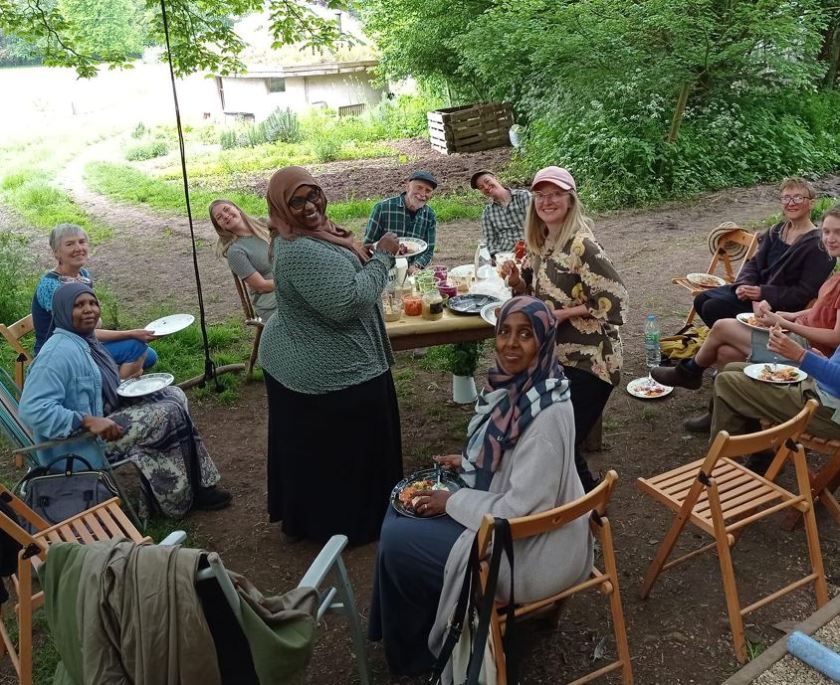
Liis presented her work with a Twinning Project in Bristol. She is working with the Somali Kitchen in Bristol (Somali Kitchen in Bristol) and Stroud Community Agriculture (https://stroudcommunityagriculture.org/sca-twinned-with-bristols-somali-kitchen-project/).
The purpose of the project is to bridge social divides and build understanding between people involved in growing food in rural areas and urban based social justice projects and the people they support. This will mean getting to know each other at events and meetings, enjoying good food and exchanging stories while learning from each other and bridging our communities.
These photos from her presentation tell the story.

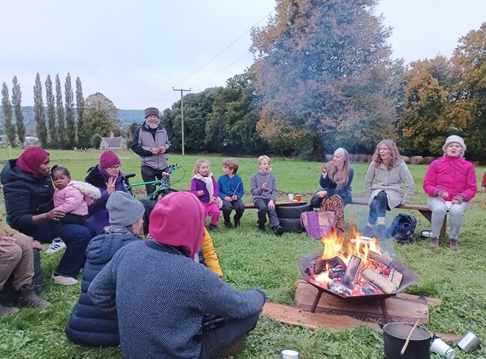
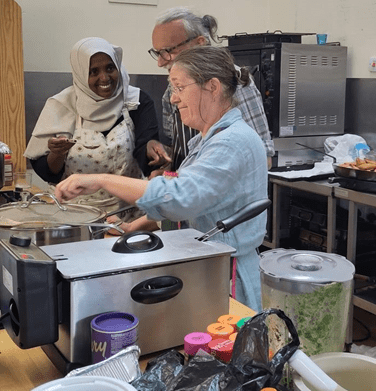
This Twinning project is one of several supported by the Real Farming Trust (see: https://realfarming.org/programmes/food-justice/twinning-bridging-social-gaps/)
The Real Farming Trust is coordinating a UK-wide 4 year project supported by the National Lottery Community Fund, called Twinning. The project aims to bridge social and cultural gaps and make it easier for people to access unfamiliar environments.
How does twinning work?
The Real Farming Trust is bringing together pairs of organisations to work in ‘twins’. Each twin will be made up of one urban and one rural group which are geographically close but socially isolated from each other. All of the partners are already working with food and in each case, one is a social justice organisation such as a food bank or refugee group.
Groups of people from both groups meet each other on both sites and understand each other’s perspectives. They decide what they would like to do together, on both sites, with both groups of people. The Real Farming Trust enables access to Community Fund National Lottery funding to implement their ideas.
 Land for What? Land for Whom?