The Land Reform Act 2025 was passed in November by the Scottish Parliament, the latest in a series of land reform acts. However, land justice campaigners do not think it will make much of a dent in the concentration of land ownership, which is only getting worse, with 421 landowners owning 50% of the private rural land, compared to 440 in 2012. Land being in the hands of so few in Scotland has resulted in a rural housing crisis, inflated land prices, depleted biodiversity, an unsustainable industrial forestry sector, an inequitable food system and an agricultural sector which is growing more consolidated.
According to Josh Noble of Community Land Scotland: “…we must also recognise that the bill does not go far enough to bring about real land reform and change Scotland’s unequal land ownership pattern. It does not intervene structurally in the land market. It does not assess who is buying land in Scotland. It does not provide routes to challenge existing ownership. It does not change the financial incentives that encourage land accumulation.” (https://www.thenational.scot/news/25668145.land-reform-pathway-tobuilding-true-people-power/)
The structural issues in the land market, together with the way money is to be made from ‘natural capital’ (e.g. trading for carbon credits), means that we are seeing a massive increase in ‘mega-lairds’. Most of these are absentee landowners: investors, billionaires and corporations. They often claim to be managing the land for nature, but their main aim is profits for themselves and marginalisation of local communities.
For example the Dane, Anders Povlsen, is the biggest private landowner in Scotland totalling around 88,406ha, largely in Sutherland, the Cairngorms, and Lochaber. Strathconon Estates in Ross-shire are another rapidly growing mega-laird, headed by Lego heiress Sofie Kirk Kristiansen, with land totalling 42,730 hectares. Another meg-laird is Oxygen Conservation (OC), an Exeter-based company with a publicly stated aim to ‘help save the world’. They have taken control of 13 estates across the UK from Cornwall to the Highlands over the past four years. They have quickly acquired five estates in Scotland which total over 48,000 acres. This includes the 12,000 -acre Invergeldie estate in Perthshire, over 15,000 acres of Dorback Estate in the Cairngorms, 11,366 acres near Newcastleton in the Borders, 523 acres of the Firth Tay and the recent purchase of the controversial 9,301 acre Kinrara Estate, west of Aviemore, from BrewDog. (https://www.communitylandscotland.org.uk/scotlands-new-mega-lairds-now-controlling-huge-areas-of-scotland/).
The Alternative
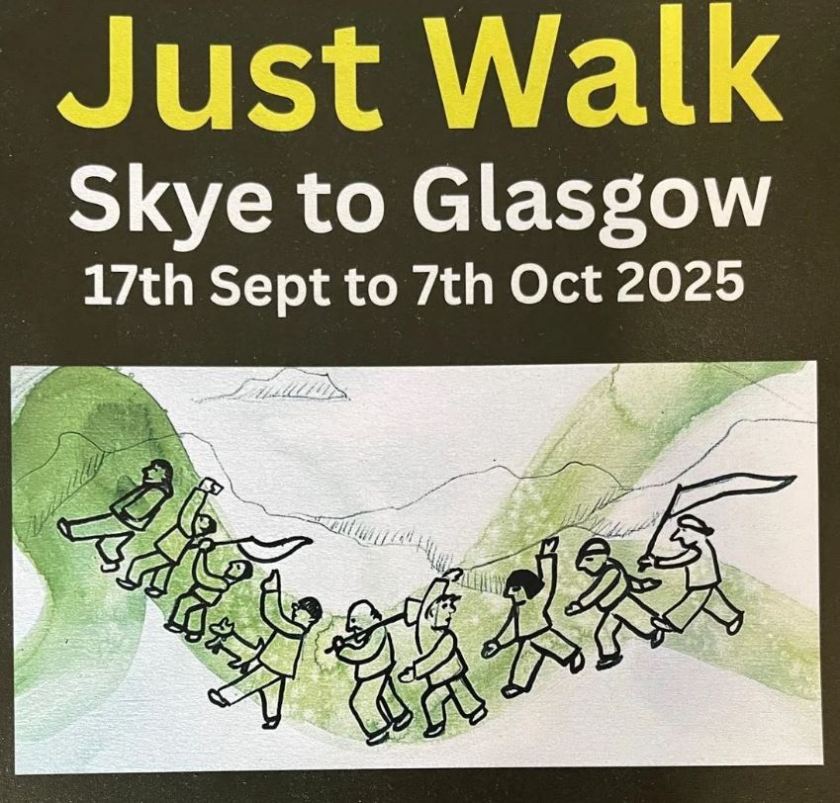
Land justice campaigners walked from Skye to Glasgow to highlight the issues faced by communities as a result of the long history of dispossession. They made clear links between what has happened in Scotland and elsewhere around the world.
“Communities were cleared from their lands by an empire that mostly turned those evicted into labourers working at the furnace of empire’s factories in Glasgow, or into colonisers sent from the quaysides to evict other communities from their lands elsewhere.”
“In the hills and the cities, in the global north and global south, how do we reclaim lands and buildings that were stolen and are now used to make some extremely wealthy and others to struggle? How do we reclaim our past and future, through our actions in the present? How do we build trust and solidarity across our differences, so that we can finally end the system of domination?”
They made sure to engage with local communities, listening to people’s stories and sharing experiences of land injustice. Such actions, linking people in the city with communities in the rural areas, are vital as they show that land justice is needed everywhere: land needs to be used for the needs of people and nature, and not for profit.
(The full story of the walk can be found at: https://www.grassroots2global.org/land-justice-walk).
 Land for What? Land for Whom?