
‘Green’ subsidies hand over millions to rich farmers
The current post-Brexit green subsidy scheme has been attacked for rewarding mainly the wealthiest landowners. In theory, the Labour government is in the process of reforming this system.
(Note that the payment system is different in Scotland- See below).
James Dyson: £2.2 million
Dyson, now Britain’s biggest farmer, made his fortune from inventions such as the bagless vacuum cleaner and is now investing in farming. He is also now the wealthiest person in the UK. He is now worth £16.2 billion.
Part of the 73-year-old’s wealth is tied up in Beeswax Dyson Farming, an agricultural business with more than 14,000ha of land and a £500m valuation.
(See: https://www.fwi.co.uk/business/markets-and-trends/britains-biggest-farmer-sir-james-dyson-tops-2020-rich-list and https://dysonfarming.com/).
Strutt and Parker Farms: £1.5 million
Strutt and Parker Farms is one of East Anglia’s oldest and well-known diversified farming businesses. It started out as basically a family business that expanded a. They have now been sold to an ‘investment company’- Robigus. The sale announcement states that Robigus is operated in conjunction with Belport, with finance provided by European investors. Belport is described as a UK-based investment and asset management company that specialises in the acquisition, development and strategic management of farms and estates.
(See: https://www.fwi.co.uk/business/strutt-parker-farms-business-sold-to-investment-company
Happy Days Farming: 840,000
This business is controlled by Truelove Property and Construction, a family-run construction business building luxury homes in Lincolnshire. Its farm business has more than 5,000 acres of cropland around Lincolnshire and Nottinghamshire. Some sources also show that they run an intensive pig-farming operation with over 2,000 pigs.
(See: https://transparentfarms.org.uk/organisations/happy-days-farming-company-limited)
Labour Reforms
Reynolds told the National Union of Farmers conference in February 2026 that the new scheme would be smaller than the previous iteration, reducing the number of paid-for environmental actions to 71 from 102. She said individual farm agreements would also be capped at £100,000, but they would be made more accessible to a wider range of farmers, especially tenant farmers. According to the Department for Environment, Food and Rural Affairs (Defra), reforms to the SFI programme have been designed to share funding more fairly, after it was assessed that one quarter of the money was going to just 4% of farms. Payments for moorland grazing will increase and smaller farms and those without current environmental land management agreements in place will be allowed to apply first in June, with other farmers allowed to apply in September.
Will these changes lead to better quality food, action against climate change and enhanced biodiversity, more support for small farmers, and a reduction in the extent and power of large landowners?
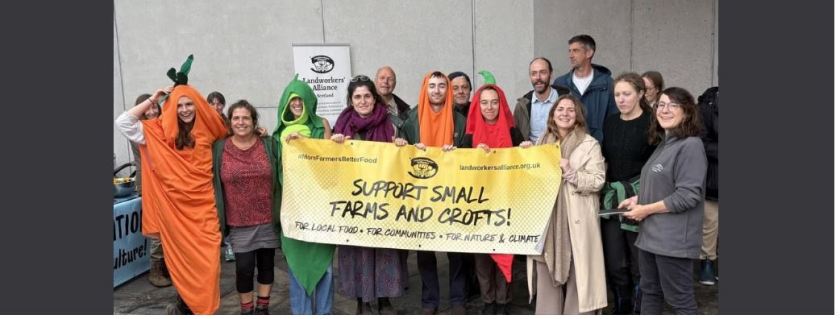
Unlikely. This is just tinkering with the system. See Landworkers Alliance demands as well as those in the People’s Land Policy’s Manifesto.
(See: https://landworkersalliance.org.uk/5-year-strategy/).
Scotland
Scotland has a different system of farm payments, still using an area based criteria, with environmental objectives added on. However, critiques have found it also fundamentally unequal.
According to Andy Wightman (2024): In 2022, 50 of the largest landowners in Scotland shared a total subsidy pot of £48m, almost £1m each of public money. The top 10 per cent of recipients (1,920 farm businesses) received £382,393,417 – almost £200,000 per business, accounting for a whopping 49.7 per cent of total available public funds.
Among those receiving over £1m were the Duke of Buccleuch, Duke of Roxburghe, the Earl of Moray and the Earl of Rosebery, who between them shared over £8m in public subsidy from a system intended to support farm incomes and rural communities.
As the Scottish Crofting Federation argued: “Under the current system, most subsidies are awarded per hectare of land and based on land quality, so those with the most land and the best land receive the most money. In recent years, the bottom 40 per cent of agricultural subsidy recipients received only five per cent of the total agricultural budget while the top 10 per cent received half of it.”
(See: https://www.holyrood.com/comment/view, big-farmer-agricultural-subsidies-are-too-heavily-concentrated-in-the-hands-of-large-landowners)
 Land for What? Land for Whom?