
(Photo Credit: Anne Burgess)
I was pleasantly surprised to see the name David Olds pop up in my latest Strathy (Badenoch and Strathspey Herald) online update. He was the head stalker during my time at Kinveachy and I met him again recently at the University Highland and Islands Integrated Land Use conference. He is now a lecturer in land use management, using his experience of working on a sporting estate as the basis for a much wider remit. It seems he has added another role- a seasoned firefighter. According to the Strathy: “Olds is an RDS, that’s a retained firefighter, for Scottish Fire and Rescue Service and says that the service relies on significant assistance from locals to fight wildfires. Because of this, he also runs regular training for land management teams to learn how to communicate and react if a wildfire hits.”
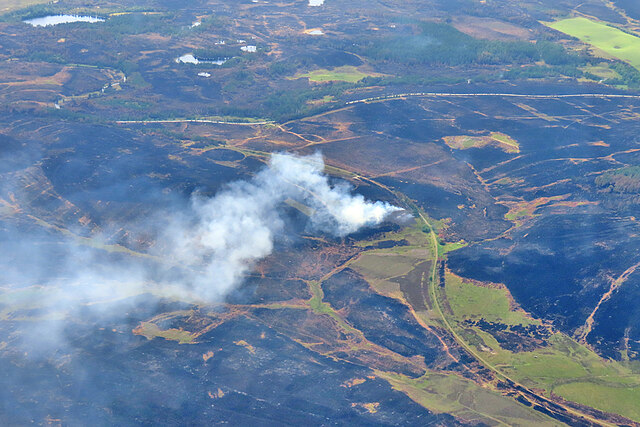
The Carrbridge and Dava wildfires (north of the Cairngorms) broke out last June, destroying over 11,000 hectares of moorland and are likely to have killed thousands of birds and animals, including hares, curlew and grouse chicks. It took 34 ATVs, 27 fogging units, 33 rural businesses – including 27 estates and two nature reserves, 50 Leaf blowers, nine tractors and five diggers to tackle the blaze. According to Olds, it is the changing climate- both hotter summers and drier springs- which are to blame. It only takes one spark to ignite an inferno.
Olds trains land management teams to create a wildfire response plan and put it into action. He helps these teams establish a leader, set up a communications system, and identify best access and rendezvous points – all of which is shared with Scottish Fire and Rescue Service in advance. Olds’ extensive experience, both in practical land management and in education, make him ideal to be heading up training programmes. He also has an intimate knowledge of the area, something which is important when planning strategy and briefing teams coming in from the outside to support.
There has been much discussion as to what actually causes the initial spark that then takes off in the fire-prone conditions. Causes are varied, but the vast majority are down to human error of some kind. It is now thought that the Carrbridge and Dava fire was caused by a flare from a helicopter involved in Search and Rescue training. It is a tragedy that this important work ended up causing so much damage and putting a huge burden on other emergency services.
The Cairngorms National Park has become the first area in the UK to establish an integrated fire management plan. BBQs and fires are now banned from April to October.
Muirburn
One controversial issue is the extent to which muirburn, the burning of small patches of heather on grouse moors to provide food for the newly born chicks, is to blame. The Scottish Government’s Wildlife Management and Muirburn Bill was passed in March 2024 and includes licensing conditions which are set to come into force this autumn. Its implementation was delayed due to landowner pressure. Many sporting estates do not want to have any regulation.
I participated in muirburn when I was doing my research on Kinveachy Estate. I found the head keeper to be very skilled and was very proud that he was able to do safe, controlled burning. As Olds says: Olds said that managed muirburn was a way to cut down the spread of wildfires. He added: “When I first started, there were a lot more sporting estates where there was managed muirburn – where they tend to manage fuel load through [controlled] rotational burning.”
However, there is concern that often there is not controlled muirburn and it is this that the legislation is designed to address. There was a serious example of a wildfire in Aberdeenshire caused by muirburn on the very day that the implementation of the legislation was delayed. The wildfire spread from the grouse moor onto a neighbouring National Nature Reserve.
The Campaign for Protection of our Moorland Communities (C4PMC) was set up by grouse moor landowners to campaign against any attacks on their traditional practices, whether grouse shooting itself or regulation of muirburn. It seems however, that the increase in wildfires has meant that people need to come together to seriously address the issue.
A Wildfire Commission has been set up and met for the first time in April to discuss, among other things, the practice of muirburn. The C4PMC welcomed this and said the event was ‘remarkable’. According to Iona McGregor, regional coordinator for the Angus Glens and Grampian Moorland Groups, the Commission works because it is “grounded in real-world experience,” bringing together “those who manage the land, those who respond to fires, and those who study them.”
From what I have read, it seems that controlled muirburn not only benefits birds such as grouse (and therefore grouse moor owners) but also reduced fuel overload, thus reducing the risk of fires igniting and spreading. However, there are still two issues. There is a risk that the controlled burning will not actually be controlled. And secondly, burning heather on peatland is a problem for climate change- there is a need to restore and extend peatland. The Scottish Wildlife Trust argues that peatlands are crucial for a number of reasons, including wildfire reduction.
So as with many issues, there is a complexity that requires people to have a holistic view, bringing together a wide variety of perspectives. However, as with other issues, land owners and their interests seem to dominate, seen in the way the legislation was delayed and how many are still fighting any regulation of muirburn. If land was in community ownership, there would still be debate and controversy over what the best course of action is. But instead of being dominated by a few powerful people, the discussion could be much more inclusive and democratic. It would be the well-being of the community and the environment which would come first.
Sources
https://www.rspb.org.uk/whats-happening/news/muirburn-legislation

