
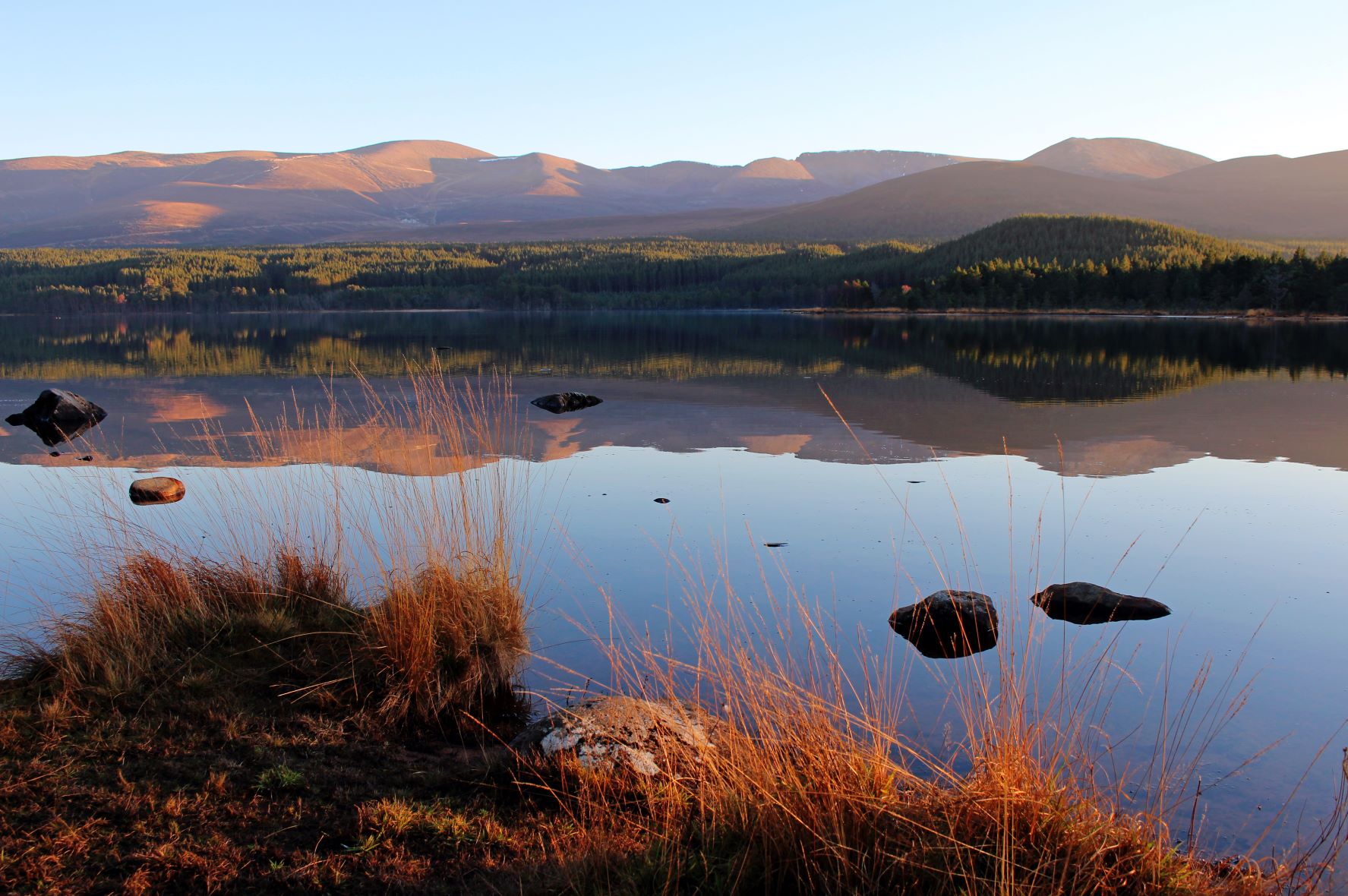
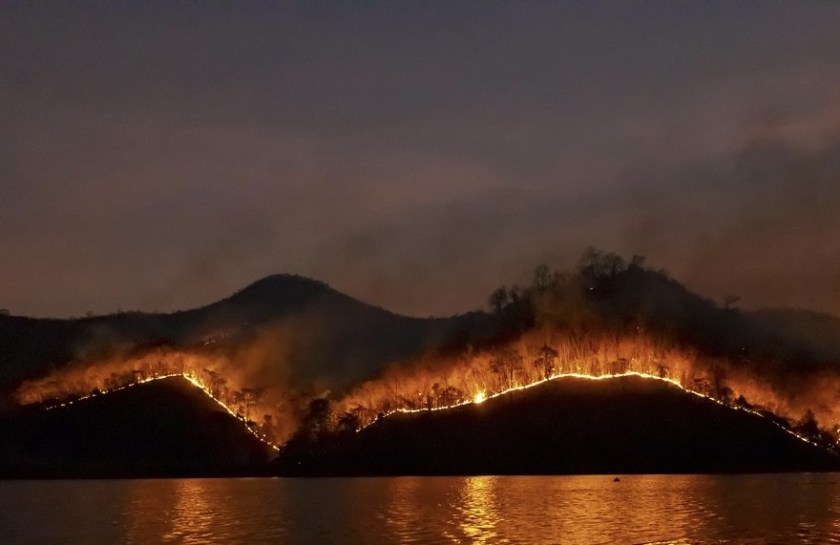
Photo from Roy Dennis Blog https://roydennis.org/roys-blog-august-2026/
Fires in the Cairngorms
The recent wildfire in the Cairngorms has left a legacy of devastation on the land and an immense sense of loss in the hearts of people. It began in the middle of July and burned across about 3,300 hectares – 33 sq km – of land, according to the Cairngorms National Park Authority. The land that was burned is dear to many locals and tourists alike. Members of the Strathspey Mountain Club went up the hill Meall a’Bhuachaille (meaning The Shepherd) when paths were opened up again after the fire to see the extent of the damage.
“Went up on Meal a B today with Doug and Val. You can see the burnt area quite clearly. It reaches from just under the lower Cairngorm car park back across the hills, right through the Ryvoan pass and all along Strath Nethy. It goes up Bynack Mor to not far from the top.
The blackness of the damage quite takes your breath away when you see it. Couldn’t see down to before the bothy or the Green Loch but it is supposed to have a lot of fire damage as it started at the junction. That route is blocked off all the way to Nethy.
Glad we saw it as you now know the extent of it. We couldn’t draw ourselves away from the viewpoint for quite some time.”
Meanwhile, workers on the land affected, such as RSPB Abernethy and Forestry and Land Scotland, are assessing the damaging and doing what they can to heal the land. However, the danger is not over. Thermal drones are being flown regularly from Abernethy to check for ‘hotspots’, fires burning underneath the ground that cannot be detected without this technology (https://www.bbc.co.uk/news/articles/cwm24n9v8rdeo).
Land Use Conflicts
The fire has sparked the usual political conflicts. A public meeting was held in Aveimore in September. The meeting was organised by the Crofters and Farmers Union with support from the British Association of Shooting and Conservation (an organisation representing traditional sporting estate landowners). The main speakers were politicians with the fire brigade and Nethy Bridge Community Council represented. It seems odd that the main landowners affected, such as RSPB, were not hosting or speaking at the meeting. Reports from the meeting indicate it was mainly about politicians trying to avoid being blamed, though some thought it was a first positive step.
Jamie Williamson, the owner of the traditional sporting and resource extraction Alive estate, has used the fire as a way of attacking the growing number of estates that are being managed for conservation purposes. In an article for the local paper, he argues:
“Aerial support to tackle wildfires becomes more important in areas where there is insufficient vehicle access, where fuel loads of dead, rank and dry vegetation have built up resulting in flames too large or difficult to control from the ground, and where management of vegetation by herbivore grazing or controlled burning has been insufficient.
This was the situation in both Glenmore and Abernethy.
Where rural areas are used to produce farm and forest products or for field sports, tracks are managed to facilitate access and the extraction of the products produced. Farm, forestry and game management staff and their equipment, along with local contractors are likely to be available to tackle wildfires. On land where controlled burning takes place on a regular basis, staff have the expertise and equipment to deal with wildfires.”
In my book I contrasted the livelihood sense of place with the conservation one. Williamson was featured in my book and his comments reinforce what I found out at the time. Land is to be used to produce something. In the same article he says:
“The UK used to invest in producing goods and services we consume including food and forest products. Over the last 30 years the UK has become less self-sufficient in energy, vehicles, metals, fertiliser and food. Our growing of forest products will soon be in decline. In this uncertain world with climate change and conflicts, we should again prioritise investment in producing the primary products our nation requires. This will ensure our rural land is more resilient to wildfires and improve our response when wildfires occur.” (https://www.strathspey-herald.co.uk/news/your-views-working-the-land-is-best-way-to-cut-the-risk-of-447196/)
He has used the wildfires as an excuse to argue for his approach to land use against those who are concerned about climate change and biodiversity.
Others have countered this attack.
Steve Micklewright, an ecologist who is involved in a number of conservation organisations, writes:
“This brings me to the attacks on rewilding. While the Cairngorms fire raged across habitats being restored for nature, the Dava mega-fire took place on land managed for sheep and shooting. The reality is that intensively managed landscapes are vulnerable. Burning and draining grouse moors creates dried out conditions and flammable monocultures. If underlying peat catches fire, it smoulders for weeks or months.
Water stops fire. Rewilding approaches including rewetted peatlands, beaver wetlands, less-flammable native broadleaf trees, re-wiggled rivers, reconnected floodplains put water back into the landscape, where it belongs, creating resilience against flooding, drought and wildfire. Natural grazing by cattle can reduce fuel loads too. It’s significant that rewetted peatland and naturally grazed areas seem to have escaped the worst of the most recent fire. Restoring nature can be one of our best long-term defences.
While sometimes land being ecologically restored may prove flammable in the short-term, that requires good stewardship – including fire breaks or natural grazing – not action against nature.”
But rather than dismissing the experience of traditional land workers, he argues for them to work together:
“For resilient, safer landscapes, we need to move beyond finger-pointing towards cooperation. Gamekeepers have much to teach rewilders about firebreaks and wildfire suppression. Rewilders can help gamekeepers restore diverse, resilient habitats. This will benefit us all – remembering we’re in a biodiversity crisis, with one-in-nine Scottish species facing extinction.” (https://www.scotsman.com/news/opinion/columnists/why-rewilding-isnt-to-blame-for-scotlands-wildfires-its-part-of-the-solution-8957791)
In a detailed article, The Big Picture gives background to the muirburn and wildfire debate. The author argues, supporting my own research findings, that the debate is more about land use.
“All this complex and conflicting evidence has allowed different groups to build arguments both for and against muirburn, often drawing selectively on the available evidence to support their views. The debate also reflects the increasingly contested nature of knowledge itself, with some placing greater value on scientific research and others leaning more on lived experience. But at its heart, the disagreement comes down to deeper questions around the purpose of our landscapes: how we reconcile biodiversity restoration, food production, energy security, ecosystem services, wildfire risks and flood prevention among all the other things we need land to provide – and whether we can agree about which changes to prioritise.” (https://www.scotlandbigpicture.com/rewilding-stories/wildfires-spark-muirburn-debate)
Who should manage the land: top-down or grass roots?
There is also another fundamental question: who actually manages the land. Dave Morris, in an article on the Parkwatch website, stresses the importance of local people in supporting the official firefighters. He argues for:
“Community-based volunteer wildfire response groups should be formalised. They should receive proper training, equipment and insurance. This should follow the existing model of mountain rescue and lifeboat services.”
The community of Nethy Bridge went through an extremely difficult time, yet many feel that they have come out stronger for it. The Nethy Bridge Café, despite losing thousands in revenue, started doing things to help out. They prepared sandwiches and soups for the firefighters and gave away coffees to the volunteer. According to the owner: “There were people who had never really met before working together. Some of the volunteers that were helping fighting the fire didn’t really know each other, so friendships were built during those days. There were also people who had moved to the village recently and that were wanting to volunteer and do things. And Polly and Ross, who run the Dell, were heroes getting people organised. The wildfire has definitely made the community feeling stronger.” https://www.pressandjournal.co.uk/fp/news/highlands-islands/7095798/nethy-bridge-businesses-cairngorm-wildfire-interviews/
This example shows what local communities can do.
It has become clear that there were some serious errors made by the Scottish government. The huge fire last year nearby, this time on land managed for grouse and sheep, led to much discussion and strategies were drawn up. Clearly, not enough lessons were learned if an even worse fire can happen a year later.
Dave Morris of Parkwatch is calling for an independent public enquiry, one that won’t drag on too long, hopefully! See his report here: https://parkswatchscotland.co.uk/2026/09/18/the-cairngorms-wildfire-why-we-need-a-public-inquiry/

