

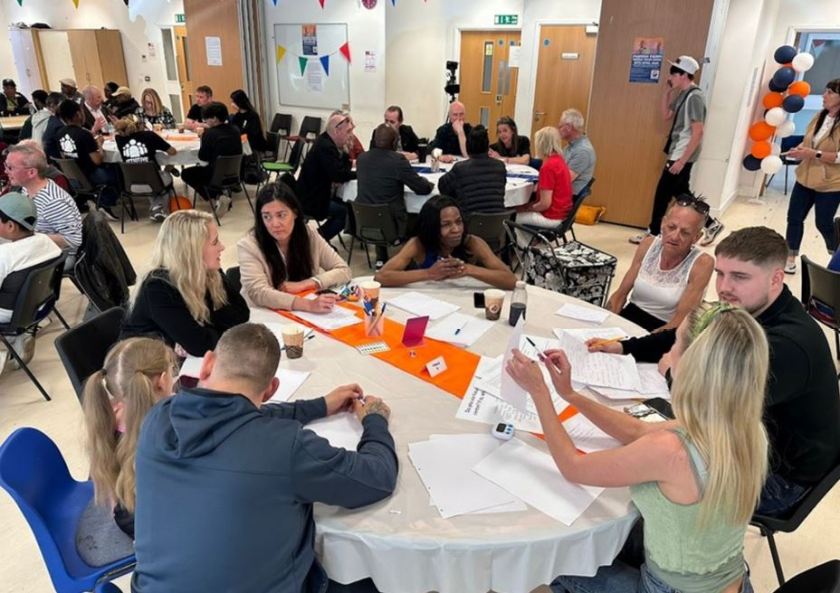
Both in my research in the Cairngorms and in my campaigning work in London, I have been very interested in how to involve more people in decision-making. Often decisions about how to use land are made by politicians, landowners, bureaucrats with only limited consultation with people in general. Consultation itself can often be a smokescreen for making it look like you have community backing. Also, it is often certain key ‘stakeholders’ who get asked their opinion- those who push themselves forward. Many voices are not heard.
Even when the community owns the land, many people for various reasons do not take part in decisions about issues that affect them. I found when visiting South Uist in May that only half of those eligible are members of the organisation that runs the island. And it only costs 1.00. So what can be done?
I found this webinar on community assemblies very interesting and it seems there is scope to use this idea to encourage more participation and to ensure that people have actual power, rather than being passive consultees.
Here is my report:
Webinar: Building Community Neighbourhood Governance for Community Power
Organised by Community Organisers, We’re Right Here, and the Humanity Project
(https://www.right-here.org/, https://www.corganisers.org.uk/, https://www.humanityproject.uk/)
“This webinar is for anyone interested in sharing power more meaningfully at a local level. We’ll introduce the core principles behind community-powered governance, discuss real-world examples like Community Covenants, Neighbourhood Assemblies, and Popular Assemblies run through Humanity Project, and create space to reflect on what this could look like in your area.
Following the passage of the English Devolution and Community Empowerment Act, new neighbourhood governance arrangements are being rolled out across the country. Join Community Organisers and We’re Right Here for a practical, interactive session exploring what this means in practice.”
Introduction
- Community Organisers is an organisation that was set up around 10 years ago in England, mainly. The aim was to galvinise local communities by working with local community organisations. We can bring people together but how do we make them effective, ie have teeth. People often have relational power but not institutional power. In other words, they may be well-organised but are not listened to by state institutions.
- One of the projects is the Humanity Project which is piloting neighbourhood assemblies, to deliberate and act on local issues. This has been done in areas of Greater Manchester, Haringey, Bristol, Luton, and Sheffield. (https://www.humanityproject.uk/happening)
What is an assembly
- These assemblies have discussed a variety of topics- food strategies, environment, local library.
- They can be a model of local governance, which is embedded in the decision-making structure of the local area. (so not anti-local authority as such)
- It can be a game-changer
- Government has in some cases really listened, other times it is a smokescreen
Principles
- Neighbourhood defined by local people- needs to be the right scale-small enough to be personal but big enough to be effective.
- Decision-making is led by relationships of mutual trust and accountability.
- Equal-basis decision-making- not just being consulted. Fully integrated and active participants.
- Leadership- drawn from civil society- not politicians
- Accountability- independent oversight
Case Study: Marsh Farm Luton
Glenn Jenkins presented their Neighbourhood Assembly project on a working class estate in Luton. It is a council estate but with 50% still council flats and the rest leaseholders or let by landlords. He said that when funding comes in to an estate for ‘regeneration’ people lose control and it becomes top-down. Assemblies are ways of talking control.
They have held one assembly which was a huge success. 150 people were involved (out of a population of 3000). It was small enough to be personal but big enough to be able to set up social enterprises. The reaction of those involved was very positive- one resident said: “That made me feel powerful”.
They set it up by first during surveys around the estate to see what issues concerned people. The two questions ended up being: how can we improve the environment and how can community assets be better used. He called these surveys: “mobilising conversations”.
There was no top table, but round ones and in groups people worked on priorities. They ended up agreeing:
1. More access to community centre
2. Space for young people
3. Bring the market back
All these have been acted upon since the assembly. There were some local politicians there who seemed positive about the event. But the assembly illustrates ‘The power of we’. 150 people was quite a lot of people and would have had a role in ensuring action from local authority.
The aim is to have these regularly- 4 a year. This is a way of building community power. If people aren’t organised they don’t have power. They are aware that they only have some of the community involved and therefore they are going to redouble efforts to mobilise people, with ‘street mobilisers’- so individuals who are in touch with a particular part of the estate.
They aim to sustain the organisation without funding, to not be dependent on external funds. “We need to be able to do what we can with the resources we have”.
Questions
Some of the issues raised in the chat were:
1. How to deal with conflict between different groups/individuals
2. What happens when the local authority cannot (or won’t) deliver the demands of the assembly
3. How to engage more people

